At Marketing League, we look at it differently. We don’t just bid more; we bid smarter. The secret weapon that allows our clients to outperform competitors with much larger budgets is a deep, technical mastery of Quality Score.
Most Google Ads advertisers throw money at the problem. They crank up bids, hoping to outmuscle competitors on the search results page. It rarely works. Studies suggest the average account wastes a significant share of its budget on keywords with poor relevance scores. The real competitive edge isn't a bigger budget. It's a smarter one.
That starts with mastering Quality Score - Google's 1-to-10 rating of how relevant your ads, keywords, and landing pages are to the person searching. A high score lowers your cost per click, improves your ad position, and drives better ROAS (Return on Ad Spend) without spending an extra dollar. A low score does the opposite. It quietly bleeds your budget dry.
One of the fastest ways to improve Quality Score is through 5 CRO tweaks that halve CPCs.
This guide breaks down the three pillars that determine your score and shows you exactly how to fix each one.
1. The Math of the "Hidden Discount"
Google Ads doesn't simply award the top spot to the highest bidder. It uses the Ad Rank Algorithm, which multiplies your maximum CPC bid by your Quality Score to determine placement.
Quality Score is graded on a scale of 1 to 10, and it is a core component of the Ad Rank formula:
This means a $2 bid with a QS of 10 produces an Ad Rank of 20. A $4 bid with a QS of 4 produces an Ad Rank of 16. The cheaper bid wins.
The financial impact compounds quickly:
- QS of 1–2: You pay up to 400% more per click than the baseline.
- QS of 5: You pay roughly the market average.
- QS of 8–10: You receive discounts of 30–50% on your CPC.
In practical terms, improving your ad quality rating from a 3 to an 8 can double your traffic on the same daily spend. That's not a marginal optimization. It's a fundamental shift in keyword bidding strategy - moving from brute-force overbidding to algorithmic efficiency.
2. Pillar One: Ad Relevance (The "Mirror" Effect)
Google rewards ads that directly mirror what the user searched for. Generic, one-size-fits-all copy kills your relevance score.
Here's the principle: if someone searches "best CRM for small law firms," your headline should say exactly that. Not "Top Business Software." Not "Grow Your Business Today." The ad must reflect the specific search intent behind the query.
This matters because search intent comes in distinct flavors. A user searching "what is a CRM" has informational intent - they're learning. A user searching "buy Salesforce license" has transactional intent - they're ready to purchase. Your ad copy must match the intent type, not just the keyword.
When you eliminate the gap between what someone searches and what your ad says, two things happen. Cognitive load drops for the user - they see their problem reflected back immediately. And Google's algorithm registers tight relevance, pushing your score upward.
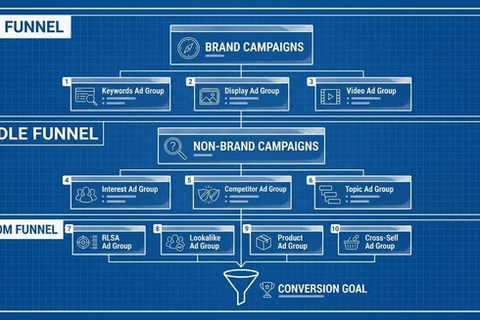
Action step: Audit your ad groups. If a single ad is serving across dozens of loosely related keywords, break it apart. Create tightly themed ad groups where every headline mirrors the core search query.
3. Pillar Two: Expected Click-Through Rate (The Popularity Contest)
Google tracks whether people actually click your ads. If users consistently skip yours in favor of a competitor's, your expected CTR drops. Your score follows.
The fix has two parts.
First, maximize your ad real estate. Use every extension available - sitelinks, callouts, structured snippets, and image extensions. Larger ads push competitors further down the page and give users more reasons to click. A fully extended ad can occupy twice the vertical space of a bare one.
Second, test relentlessly. Run responsive search ads with multiple headline and description variations. Let Google's machine learning surface the best-performing combinations. Then review the results monthly. Kill underperformers. Double down on winners.
This iterative testing doesn't just boost CTR. It feeds directly into Conversion Rate Optimization (CRO). The headlines that earn clicks also tend to set clearer expectations, which means visitors who land on your page are more qualified and more likely to convert.
4. Pillar Three: Landing Page Experience (The Final Frontier)
Your ad got the click. Now the landing page has to deliver on the promise.
Google evaluates two critical factors here.
Continuity. The headline on your landing page must match the ad that brought the user there. If your ad says "Affordable CRM for Law Firms," the landing page should not open with "Welcome to Our Software Platform." That disconnect tanks your score and your conversion rate simultaneously.
Technical performance. Pages must load in under three seconds. Mobile Core Web Vitals - Largest Contentful Paint, Cumulative Layout Shift, First Input Delay - must all pass. A slow, janky page tells Google your experience is poor. They'll charge you more for every click as a result.
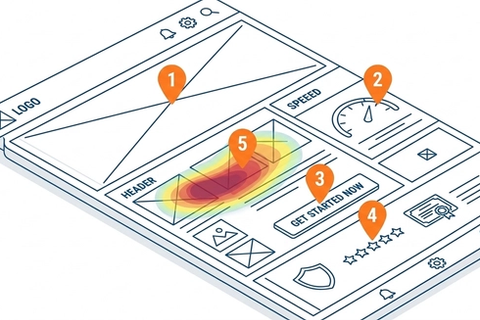
But landing page optimization goes beyond speed and headline matching. This is where CRO principles compound the value of a high Quality Score. Clear calls to action, minimal form fields, trust signals like testimonials and security badges, and a distraction-free layout all improve conversion rates. When you pay less per click and convert more of those clicks into leads, your ROAS improves on two axes at once.
Case Study: A 150%+ Quality Score Lift for a Global Fintech Leader
The power of this blueprint is best seen in action. Recently, a global Fintech firm approached Marketing League with skyrocketing CPCs in the hyper-competitive Business Credit space.
The Challenge:
The client had a disastrous average Quality Score of 1 out of 10. Because they were using generic, brand-focused ads for highly specific, product-focused searches, Google was hitting them with a massive penalty tax. They were paying $80 per click just to maintain visibility on the first page.
The Marketing League Intervention:
We moved away from general messaging and implemented a High-Relevance Intent Strategy. We completely rewrote their ads to ensure that every specific search term was met with a specific, mirrored ad headline that addressed the user's immediate need. We then paired this with Landing Page Optimization, ensuring the Mirror Effect followed the user from the search results all the way to the conversion form.
The Results:
- Quality Score: Average QS jumped from 1/10 to 8/10.
- CPC Reduction: Their average Cost Per Click dropped by over 60%.
- Scaling: We doubled their lead volume by reinvesting the saved budget back into the most efficient auctions.
The Marketing League Advantage: Turning Data into Leverage
Google Ads success isn't about who spends the most. It's about who aligns most tightly with what Google rewards: relevant ads, strong click-through rates, and fast, focused landing pages.
The three pillars work together. Tight ad relevance drives higher CTR. Higher CTR earns lower CPCs. Lower CPCs free up budget for better landing pages and deeper conversion optimization. It's a virtuous cycle - and it starts with understanding that your ad quality rating is not a vanity metric. It is the single highest-leverage variable in your Google Ads account.
Stop outbidding. Start outsmarting. By improving your score and moving away from generic ads, you lower your barrier to entry and unlock growth that compounds over time.
At Marketing League, we don't just run ads - we engineer growth. Our team of specialists looks deep into the engine of your account to find the hidden inefficiencies that standard automation misses. Whether it is the mathematical precision of Portfolio Bidding or the psychological bridge of a 10/10 Quality Score, we ensure your budget is an investment, not an expense.
Is Your Google Ads Account Ready for True Scale?
If you are a global brand or a high-growth startup currently spending over $20k a month and seeing stagnant performance, you are likely suffering from the Relevance Tax.
Want us to find the leaks in your account like we did for our Fintech partners?
The Marketing League Takeaway
Google Ads is no longer just about who bids the most - it is about who manages the algorithm the best. By increasing your Quality Score and moving away from generic ads, you are lowering your barrier to entry and forcing your competitors to pay more for the same traffic.
At Marketing League, we do not just aim for the target. We optimize the spend so that every dollar works toward your highest possible ROI.