Introduction
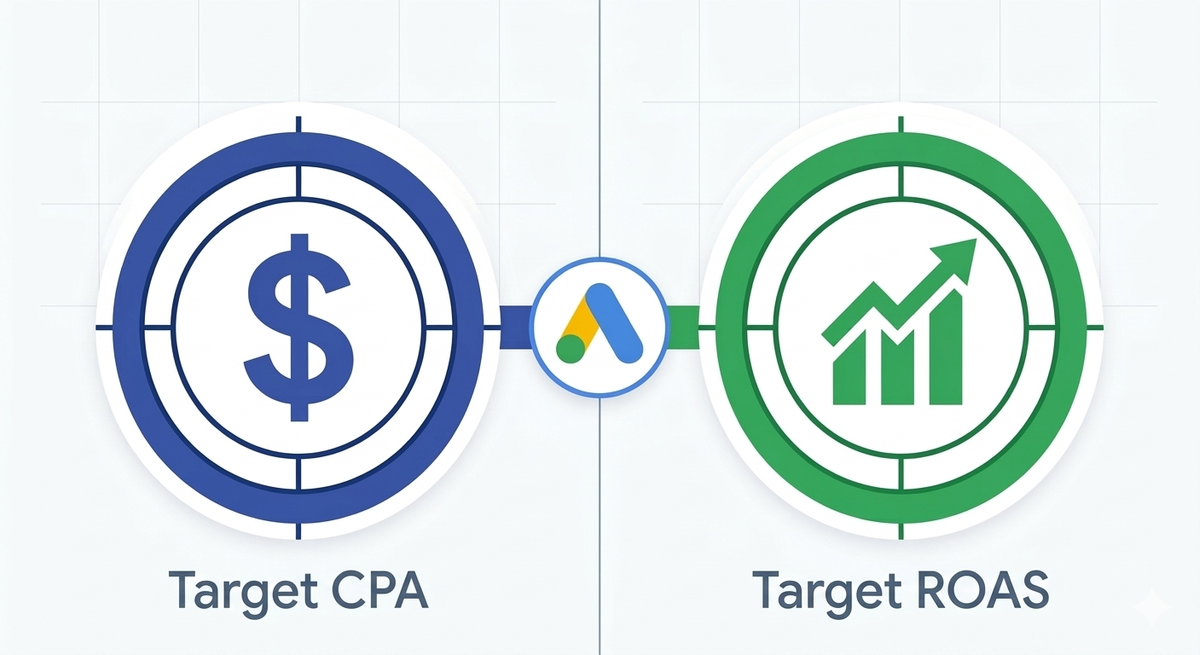
Google Ads gives you two headline Smart Bidding strategies: Target CPA and Target ROAS. Both use machine learning to set bids in real time. Both promise better results than manual bidding. But they optimize for fundamentally different outcomes.
Target CPA aims to get you as many conversions as possible at a fixed cost per action. Target ROAS aims to maximize conversion value relative to your ad spend. Same engine. Different destinations.
Picking the wrong one doesn't just waste budget. It trains Google's algorithm on the wrong objective - and the longer it learns the wrong lesson, the harder it is to correct course. This guide breaks down how each strategy works, when to use it, and how to avoid the most common mistakes advertisers make in 2026.
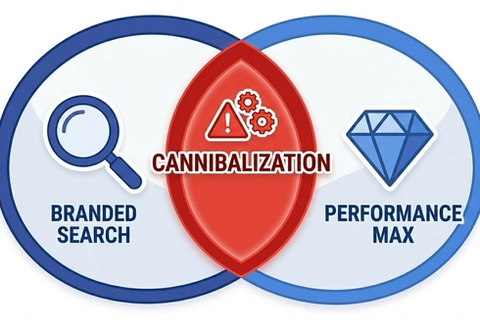
If you're running Performance Max alongside Smart Bidding, watch out for Performance Max cannibalization risk.
For B2B companies, bidding strategies require special tuning — see our B2B SaaS bidding strategies
How Smart Bidding Actually Works
Before comparing the two strategies, it helps to understand what powers both of them.
Smart Bidding is Google's umbrella term for automated bidding strategies that use auction-time machine learning. Every time someone triggers an ad auction, Google evaluates dozens of real-time signals - device, location, time of day, browser, audience list membership, search intent cues - and sets a bid designed to meet your performance target.
This is not a set-it-and-forget-it system. Smart Bidding enters an algorithmic learning phase every time you make a significant change - new target, new budget, new conversion action. During this phase, which typically lasts 7 to 14 days, performance may fluctuate as the algorithm gathers data. Making changes during this window resets the clock and delays optimization.
The key takeaway: both Target CPA and Target ROAS rely on the same machine learning backbone. The difference is what you tell that machine to optimize for.
Target CPA: Optimize for Cost Per Conversion
Target CPA tells Google: "Get me conversions at or below this dollar amount."
You set a target - say, $50 per lead. Google's algorithm then adjusts bids up or down at auction time to hit that average. Some conversions will cost $35. Others might cost $65. Over time, the system aims to average out at your target.
Best for:
- Lead generation businesses where every lead has roughly equal value
- Service businesses with a fixed customer acquisition cost threshold
- Campaigns where you track form fills, phone calls, or demo requests as conversions
- Advertisers who need predictable cost controls and clear CPA limits
Strengths:
- Simple to set up and manage. One number defines success.
- Highly effective when conversion values are uniform - a lead is a lead.
- Easier to forecast. If your target CPA is $50 and your budget is $5,000, you can reasonably expect around 100 conversions.
- Works well with smaller conversion volumes. Google recommends at least 30 conversions in the last 30 days, but Target CPA tends to stabilize faster than Target ROAS.
Weaknesses:
- Treats every conversion as equal. A $500 sale and a $5,000 sale both count the same.
- Can throttle spend aggressively if the target is too tight, starving the campaign of data.
- No mechanism to chase higher-value outcomes. The algorithm has no concept of revenue.
Target ROAS: Optimize for Return on Ad Spend
Target ROAS tells Google: "For every dollar I spend, bring me this much in conversion value."
You set a percentage target - say, 400%. That means for every $1 spent, you expect $4 in return. Google then bids higher on auctions likely to produce high-value conversions and pulls back on low-value ones.
Best for:
- E-commerce businesses where products have different price points
- Any business that tracks revenue or deal value as a conversion metric
- Campaigns where a $200 sale and a $2,000 sale should not receive equal bidding weight
- Advertisers focused on profitability rather than volume
Strengths:
- Prioritizes value, not just volume. The algorithm learns which clicks produce the highest returns.
- Ideal for product catalogs with wide price ranges. Google bids more for the $500 item search and less for the $15 accessory.
- Aligns ad spend directly with business outcomes. Your advertising becomes a measurable investment with a target return rate.
Weaknesses:
- Requires accurate conversion value tracking. If your value data is wrong, the algorithm optimizes toward garbage.
- Needs higher conversion volume to stabilize. Google recommends at least 50 conversions in the last 30 days with associated values.
- Can be volatile during the learning phase, especially with inconsistent transaction values.
- More complex to manage. You need clean data pipelines and regular audits of your value tracking.
Head-to-Head Comparison
| Factor | Target CPA | Target ROAS |
|---|---|---|
| Optimizes for | Conversion volume at a fixed cost | Conversion value relative to spend |
| Best metric | Cost per lead/action | Return on ad spend |
| Data requirement | 30+ conversions/month | 50+ conversions with values/month |
| Setup complexity | Low | Medium to high |
| Value sensitivity | None - all conversions equal | High - bids shift by value |
| Budget predictability | High | Moderate |
| Risk of throttling | Medium (if target too tight) | Medium (if ROAS target too aggressive) |
| Ideal for | Lead gen, services, uniform actions | E-commerce, variable deal sizes |
When to Use Target CPA
Scenario 1: Lead generation with uniform value. You run a B2B SaaS company. Every demo request is worth roughly the same to your sales team. There is no meaningful difference between a lead from a startup and a lead from an enterprise company at the top of funnel. Set a Target CPA that reflects your maximum allowable customer acquisition cost and let the algorithm find volume.
Scenario 2: Strict CPA limits from finance. Your CFO says every lead must cost $40 or less. There is no flexibility. Target CPA gives you a hard guardrail. Pair it with portfolio-level CPA limits to cap costs across multiple campaigns simultaneously.
Scenario 3: Low conversion volume. You are running a niche campaign that generates 30 to 50 conversions per month. Target CPA stabilizes faster on thinner data. Target ROAS would likely stay stuck in the learning phase.
When to Use Target ROAS
Scenario 1: E-commerce with a wide product catalog. You sell products ranging from $20 to $2,000. Target CPA would bid the same for both. Target ROAS bids aggressively for the high-ticket items and conservatively for the low-margin ones. Your budget automatically shifts toward profitability.
Scenario 2: Revenue-driven growth targets. Your KPI is not "how many conversions" but "how much revenue per dollar spent." Target ROAS directly aligns your bidding with this objective. If your target is 500%, every $1 in spend should yield $5 in tracked revenue.
Scenario 3: Conversion value rules in play. Google Ads now supports conversion value rules - adjustments that modify reported conversion values based on audience, location, or device. For example, you can tell Google that conversions from returning customers are worth 50% more. Target ROAS uses these adjusted values in real time, making your bidding smarter without changing your actual tracking. Target CPA ignores value rules entirely.
Common Mistakes That Wreck Both Strategies
Setting targets based on aspiration, not data. Your target CPA or ROAS should reflect recent actual performance, not a dream number. Start with your 30-day average and adjust gradually - no more than 15-20% at a time.
Changing targets during the learning phase. Every significant change resets the algorithmic learning phase. If you adjust your target on day 5 of a 14-day learning window, you just added another 14 days. Be patient. Let the data accumulate.
Ignoring conversion tracking accuracy. Automated bidding is only as good as the data it receives. Duplicate conversions, missing values, or misconfigured tags will send the algorithm in the wrong direction. Audit your conversion setup quarterly at minimum.
Running both strategies against each other on the same keywords. If you have a Target CPA campaign and a Target ROAS campaign bidding on the same terms, they compete against each other in the auction. This drives up your costs and confuses both algorithms. Keep your campaign structure clean.
Setting CPA limits too tight on Target ROAS. Google allows you to add a maximum CPA cap alongside your Target ROAS. This sounds like a safety net, but overly tight CPA limits can prevent the algorithm from bidding on high-value opportunities. Use them sparingly.
The Hybrid Approach: Portfolio Bidding
You don't have to choose one strategy for your entire account. Portfolio bid strategies let you group campaigns under a shared Target CPA or Target ROAS with unified budgets and CPA limits.
The practical application: run Target CPA on your lead gen campaigns and Target ROAS on your e-commerce campaigns. Each portfolio optimizes independently toward the right objective. The algorithm gets cleaner signals. Your reporting stays organized.
In 2026, Google's Smart Bidding models have access to more auction signals than ever before. The advertisers who win are the ones who feed those models the right objective - not the ones who spend the most.
So Which One Wins?
Neither. The right strategy depends entirely on your business model and data maturity.
Choose Target CPA if your conversions are roughly equal in value, your volume is moderate, and you need simple cost controls.
Choose Target ROAS if your conversions vary significantly in value, you have strong volume with accurate value tracking, and your goal is profitability over volume.
The real mistake is not picking the wrong strategy. It is sticking with the wrong one after the data tells you to switch. Review performance monthly. If Target CPA is capping your growth because it cannot distinguish a $200 deal from a $20,000 deal, migrate to Target ROAS. If Target ROAS is thrashing because you lack conversion volume, simplify to Target CPA.
Smart Bidding rewards clarity. Tell Google exactly what success looks like for your business - then give the algorithm the room and the data to find it.
Frequently Asked Questions
What is the difference between Target CPA and Target ROAS?
Target CPA optimizes for a fixed cost per conversion. It treats every conversion equally and tries to hit your desired cost per action. Target ROAS optimizes for conversion value relative to spend. It bids higher on clicks likely to produce high-value conversions and lower on clicks expected to produce low-value ones. Choose Target CPA when all conversions are worth roughly the same. Choose Target ROAS when conversion values vary significantly.
How many conversions do I need before switching to Smart Bidding?
Google recommends at least 30 conversions in the last 30 days for Target CPA and at least 50 conversions with associated values in the last 30 days for Target ROAS. These are minimums. Both strategies perform better with higher volumes. If you are below these thresholds, consider using Maximize Conversions or Maximize Conversion Value without a target first to build up your data.
What is the algorithmic learning phase and how long does it last?
The learning phase is the period after a significant change when Google's algorithm is recalibrating its bidding model. It typically lasts 7 to 14 days. During this window, performance may fluctuate - costs can spike or volume can dip. Avoid making additional changes during this period. Every new adjustment resets the clock and delays optimization.
Can I switch from Target CPA to Target ROAS mid-campaign?
Yes, but do it carefully. Switching strategies triggers a new learning phase. Before switching, make sure you have accurate conversion value tracking in place and at least 50 valued conversions in the last 30 days. Set your initial ROAS target based on your actual historical ROAS, not an aspirational number. Monitor closely for two weeks and resist the urge to adjust during the learning window.
What should I set my Target CPA or Target ROAS to?
Start with your actual recent performance, not a goal. Pull your average CPA or ROAS from the last 30 days and set your target at or slightly above that baseline. Once the algorithm stabilizes, adjust gradually - no more than 15 to 20% at a time. Setting an aggressive target from the start will cause the algorithm to restrict spend and you will lose volume.
Do conversion value rules work with Target CPA?
No. Conversion value rules - which let you adjust reported values based on audience, location, or device - are only used by value-based bidding strategies like Target ROAS and Maximize Conversion Value. Target CPA ignores value rules entirely because it optimizes for conversion count, not conversion value. If you want to leverage value rules, you need to be on a ROAS-based strategy.
Should I use CPA limits alongside Target ROAS?
Use them sparingly. Google allows you to set a maximum CPA cap on Target ROAS campaigns as a safety net. However, overly tight CPA limits prevent the algorithm from bidding on high-value opportunities that might cost more per click but deliver outsized returns. If you set a CPA limit, keep it at least 30 to 50% above your average CPA to give the algorithm room to operate.
Can I run Target CPA and Target ROAS in the same account?
Yes, and in many cases you should. Use portfolio bid strategies to group campaigns by objective. Run Target CPA on lead generation campaigns where conversions have uniform value. Run Target ROAS on e-commerce or revenue-driven campaigns where values vary. The key rule is never run both strategies on campaigns competing for the same keywords. That creates internal auction competition and degrades performance for both.
What happens if my conversion tracking is inaccurate?
Both strategies will optimize toward bad data. Target CPA will chase conversions that may not be real - duplicate form submissions, bot clicks, or misconfigured events. Target ROAS will bid based on incorrect values, potentially overspending on low-value conversions or ignoring high-value ones. Audit your conversion tracking quarterly. Check for duplicates, verify values against your CRM or payment processor, and test your tags after any website changes.